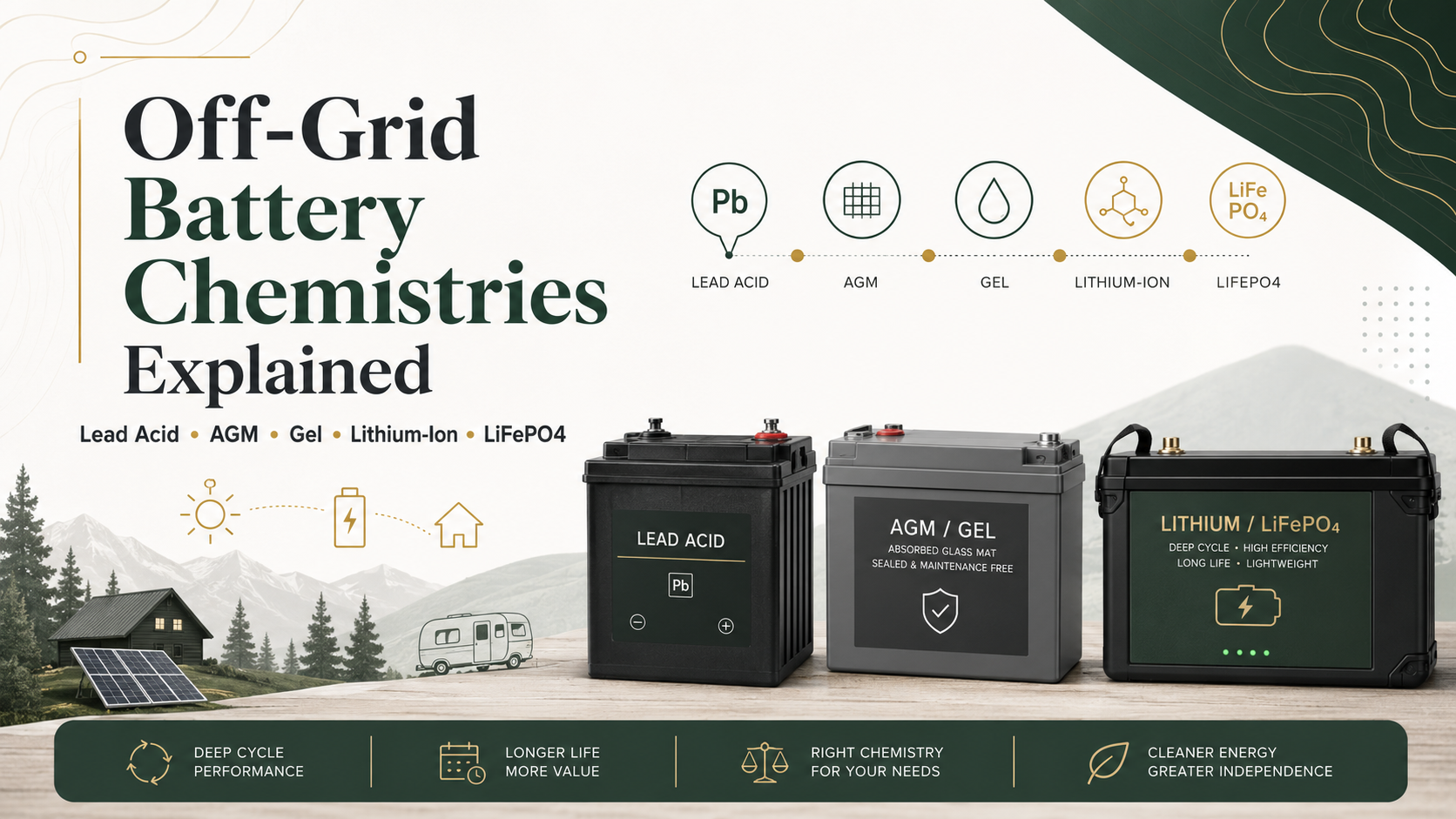
Off-grid batteries store electrical energy so it can be used when solar panels, generators or the grid are not actively supplying power. The most common battery chemistries used in off-grid and backup systems are lead acid, AGM, gel, lithium-ion and lithium iron phosphate, usually shortened to LiFePO4 or LFP.
Each chemistry has different strengths. Lead acid batteries are well established and often cheaper upfront. AGM and gel batteries are sealed lead acid options that are common in leisure, marine, backup and off-grid applications. Lithium-ion batteries are lighter and more energy dense. LiFePO4 batteries are a type of lithium-ion battery that has become especially popular in batteries and storage, portable power, campervan, cabin and solar setups because of their cycle life, stable chemistry and usable capacity.
There is no single best chemistry for every job. The right choice depends on budget, available space, charging equipment, expected usage, temperature range, installation environment and how often the battery will be cycled.
This guide is a plain-English overview, not installation advice. Always follow the manufacturer's instructions and use suitably rated chargers, cables, fuses, protection devices and enclosures. For fixed, high-capacity or mains-connected systems, speak to a qualified professional.
When you are ready to compare real products, you can browse our battery and storage range. The notes below should help you read the specifications more confidently.
Why battery chemistry matters
When people compare off-grid batteries, they often focus only on headline capacity, such as 100Ah, 200Ah or 5kWh. Capacity matters, but chemistry affects how that capacity behaves in real use.
Battery chemistry can influence:
- How much of the battery capacity you can regularly use
- How heavy and bulky the battery is
- How long the battery may last under repeated cycling
- Charging speed and charging requirements
- Cold weather performance
- Maintenance needs
- Upfront cost versus lifetime cost
- Suitability for solar, campervan, cabin, marine or emergency backup use
Two batteries may both be labelled 100Ah, but they may not offer the same practical usable energy in day-to-day use. Some chemistries are happier being deeply discharged than others. Some are more forgiving but heavier. Some require a battery management system. Some are better suited to occasional standby use, while others are better suited to daily solar cycling.
What is a lead acid battery?
A lead acid battery is one of the oldest and most widely used rechargeable battery types. It stores energy through a chemical reaction between lead plates and a sulphuric acid electrolyte.
Lead acid batteries are commonly found in cars, boats, backup power systems, mobility equipment, forklifts and older off-grid solar installations. They remain popular because they are relatively affordable, widely available and well understood.
Common lead acid types
There are several versions of lead acid battery:
- Flooded lead acid batteries
- AGM batteries
- Gel batteries
Flooded lead acid batteries contain liquid electrolyte and may require maintenance, including checking electrolyte levels where applicable. They must be installed and charged correctly, with suitable ventilation and protection.
When might someone choose lead acid?
Lead acid may still make sense if:
- Upfront budget is the main concern
- Weight and size are not major issues
- The system is used occasionally rather than cycled heavily every day
- Existing charging equipment is designed for lead acid
- The application is simple, proven and low cost
Lead acid can still suit some standby, backup, leisure and entry-level systems. The trade-off is that it is usually heavier and bulkier than lithium options for the same usable energy.
Things to bear in mind
Lead acid batteries are generally less tolerant of deep regular discharging than many lithium-based alternatives. In practical systems, users often avoid heavily discharging them in order to preserve battery life. They can also require more attention around charging, ventilation, weight, positioning and maintenance depending on the specific type.
What is an AGM battery?
An AGM battery is a sealed lead acid battery that uses absorbent glass mat separators to hold the electrolyte. AGM batteries are often described as maintenance-free because they are sealed and do not usually require topping up with water.
AGM batteries are common in:
- Campervans and motorhomes
- Boats and marine systems
- UPS and backup systems
- Leisure batteries
- Engine starting and dual-purpose applications
- Smaller off-grid setups
AGM can be a practical middle-ground option. It is usually cleaner and easier to live with than flooded lead acid, while still being based on familiar lead acid technology.
When might someone choose AGM?
AGM may suit users who want:
- A sealed battery
- Reasonable upfront cost
- Compatibility with many existing lead acid chargers
- Good availability
- A straightforward leisure or backup battery
AGM is not the lightest or most energy-dense option, and it may not be the most cost-effective choice for heavy daily cycling. For many simple systems, though, it remains a familiar and practical battery type.
What is a gel battery?
A gel battery is a sealed lead acid battery where the electrolyte is held in a gel form. This makes the battery spill-resistant and useful in some applications where a sealed design is preferred.
Gel batteries are often used in specialist deep-cycle applications, mobility equipment, some renewable systems and certain standby uses.
When might someone choose gel?
Gel batteries may be considered where:
- A sealed battery is required
- The battery will be used in a deep-cycle role
- The charger is specifically compatible with gel charging profiles
- The installation benefits from a spill-resistant design
Gel batteries can be sensitive to incorrect charging. A charger that is suitable for one lead acid type may not automatically be suitable for gel, so it is worth checking the manufacturer's charging requirements carefully.
What is a lithium-ion battery?
A lithium-ion battery is a rechargeable battery that stores energy using lithium ions moving between the battery's electrodes. Lithium-ion does not refer to one exact chemistry. It is an umbrella term covering several related chemistries.
Lithium-ion batteries are used in:
- Phones and laptops
- Electric vehicles
- Power tools
- Portable power stations
- Home battery systems
- Solar storage
- E-bikes and mobility products
Lithium-ion batteries are popular because they can store a lot of energy for their size and weight. They are typically lighter than lead acid batteries and can often deliver more usable energy from a smaller package.
Common lithium-ion chemistries
Some common lithium-ion chemistries include:
- NMC: lithium nickel manganese cobalt oxide
- NCA: lithium nickel cobalt aluminium oxide
- LCO: lithium cobalt oxide
- LMO: lithium manganese oxide
- LFP / LiFePO4: lithium iron phosphate
For off-grid use and solar panels paired with storage, LiFePO4 is one of the most commonly discussed lithium options.
When might someone choose lithium-ion?
A consumer may choose lithium-ion when:
- Weight matters
- Space is limited
- Higher usable capacity is important
- The battery will be cycled frequently
- Faster charging is desired
- A portable power station or integrated battery system is preferred
Lithium-based systems must be used with suitable battery management, charging equipment and protection. Do not mix battery types, chargers or system components unless the manufacturer specifically supports it.
What is a LiFePO4 battery?
A LiFePO4 battery, also called LFP or lithium iron phosphate, is a type of lithium-ion battery. It uses lithium iron phosphate as the cathode material.
LiFePO4 batteries have become one of the most popular battery chemistries for off-grid power, solar storage, campervans, cabins, boats, portable power stations and home backup products.
Why is LiFePO4 popular for off-grid power?
LiFePO4 is popular because it usually offers a strong combination of:
- Long cycle life
- Good usable capacity
- Lower weight than lead acid
- Stable lithium chemistry
- Low maintenance
- Good suitability for solar cycling
- Compatibility with modern battery management systems
Compared with many lead acid batteries, LiFePO4 batteries are often more expensive upfront. In daily-use systems, though, the longer cycle life and greater usable capacity can make them attractive over time.
When might someone choose LiFePO4?
LiFePO4 may be a good fit for consumers who want:
- A solar battery for regular cycling
- A campervan, motorhome or boat leisure battery
- A portable power station
- A cabin or shed power system
- Backup power that is lighter and more compact than lead acid
- A battery that can be used more deeply within manufacturer limits
LiFePO4 is not automatically the right answer for every system. It still needs suitable charging, cable sizing, fusing, installation and temperature consideration. Some LiFePO4 batteries should not be charged below certain temperatures unless they include built-in low-temperature protection or heating.
Lead acid vs lithium-ion vs LiFePO4: quick comparison
| Battery type | Typical strengths | Typical trade-offs | Common off-grid uses |
|---|---|---|---|
| Flooded lead acid | Low upfront cost, widely understood, available | Heavy, may require maintenance, ventilation considerations | Older solar systems, basic backup, industrial uses |
| AGM lead acid | Sealed, robust, widely available, familiar | Heavy, less usable capacity than many lithium options | Leisure batteries, boats, campervans, UPS |
| Gel lead acid | Sealed, spill-resistant, deep-cycle capable in suitable systems | Needs correct charging profile, heavy | Mobility, standby, specialist deep-cycle systems |
| Lithium-ion | Lightweight, high energy density, common in portable systems | Needs suitable management and protection | Portable power, tools, EV-style storage, compact systems |
| LiFePO4 / LFP | Long cycle life, stable chemistry, popular for solar/off-grid | Higher upfront cost, needs compatible charging and BMS | Solar storage, campervans, cabins, boats, home backup |
Actual performance always depends on the specific product, brand, temperature, discharge rate, battery management system and how the battery is used.
What is depth of discharge?
Depth of discharge, often shortened to DoD, means how much of a battery's stored energy has been used.
For example, if a fully charged battery has 100Ah of capacity and you use 50Ah, that is a 50% depth of discharge.
Depth of discharge matters because batteries age as they are charged and discharged. Some chemistries tolerate deeper regular discharge better than others. In many off-grid systems, this affects how much practical usable energy you can expect from the battery.
A larger nominal battery is not always better if only a smaller portion of that capacity should be used regularly. This is one reason chemistry matters, not just capacity.
What is cycle life?
Cycle life is the number of charge and discharge cycles a battery is expected to deliver before its capacity falls to a defined level, often around 80% of its original capacity.
Cycle life depends on:
- Depth of discharge
- Charging method
- Temperature
- Discharge rate
- Storage conditions
- Product quality
- Battery management
- Whether the battery is used within its stated specification
For occasional backup use, cycle life may be less important than upfront price. For daily solar storage, it can be one of the most important factors.
What is a battery management system?
A battery management system, or BMS, is an electronic system that monitors and protects a battery. It is especially important in lithium-based batteries.
A BMS may help monitor or manage:
- Cell voltage
- Charge and discharge limits
- Temperature
- Over-current protection
- Low-voltage protection
- High-voltage protection
- Cell balancing
Not all battery management systems are the same. A quality battery should still be used within its stated specification and paired with compatible equipment.
Which chemistry suits solar storage?
For modern small-scale solar and off-grid use, LiFePO4 is often one of the most popular choices because it offers a strong mix of usable capacity, cycle life, weight and low maintenance.
That does not mean it is always the best choice for every customer. A simple, low-cost system used only occasionally may still suit AGM or another lead acid option. A portable power station may use LiFePO4 or another lithium-ion chemistry depending on the model. A fixed home battery should be chosen as part of a properly designed system, alongside compatible charge controllers and chargers and the rest of the system.
For system planning, it can also be useful to compare solar panels, solar kits and inverters alongside the battery, rather than treating storage as a standalone purchase.
The better question is not simply which chemistry is best, but:
- How often will the battery be used?
- How much energy needs to be stored?
- Is weight important?
- Is it for daily cycling or emergency backup?
- Will it be charged by solar, mains, alternator or generator?
- What temperatures will it operate in?
- Is the charger compatible?
- Does the installation need professional design?
Which chemistry suits campervans and motorhomes?
For campervans and motorhomes, LiFePO4 is increasingly popular because it offers high usable capacity in a lighter package than traditional lead acid leisure batteries. This can be helpful when running fridges, lights, laptops, inverters and other off-grid loads.
AGM batteries are still widely used and may suit lower-cost or simpler leisure systems, especially where the existing charger and electrical system are designed around lead acid.
Before upgrading from lead acid to lithium, check compatibility with the vehicle charging system, solar controller, mains charger, inverter and any battery monitoring equipment. A lithium upgrade is not always a simple like-for-like replacement.
Which chemistry suits cabins, sheds and remote buildings?
For cabins, sheds and remote buildings, the choice depends on how the system is used.
LiFePO4 can be well suited to regular solar cycling, especially where the battery is used daily. Lead acid may suit simpler or lower-budget systems, particularly if the energy demand is modest and the battery is not deeply discharged.
Fixed off-grid systems should be designed with proper attention to battery capacity, charging source, inverter size, cable protection, ventilation, temperature, weather protection and maintenance access. For anything beyond a small plug-and-play system, professional advice is recommended.
Safety notes for off-grid batteries
Batteries store a lot of energy. Even small systems can deliver high current if short-circuited, and larger systems can present serious risks if incorrectly installed or used.
General safety considerations include:
- Use batteries only with compatible chargers and controllers
- Follow the manufacturer's instructions
- Use correctly rated cables, fuses and protection devices
- Avoid mixing battery chemistries unless a system is designed for it
- Do not use damaged, swollen, leaking or overheated batteries
- Keep batteries away from unnecessary heat, moisture and physical damage
- Ensure suitable ventilation where required
- Do not bypass battery management or protection systems
- Seek professional help for fixed, high-capacity or mains-connected systems
This guide is for general product education only. It is not a substitute for manufacturer instructions, electrical design, installation guidance or professional advice.
Quick buyer guide
Choose lead acid if:
- You want the lowest upfront cost
- Weight and size are not major concerns
- The system is simple and familiar
- The battery will be used occasionally
- You already have compatible lead acid charging equipment
Choose AGM if:
- You want a sealed lead acid battery
- You need a familiar leisure or backup battery
- You want lower maintenance than flooded lead acid
- You are working with existing lead acid-compatible equipment
Choose gel if:
- You need a sealed deep-cycle battery
- The charger is designed for gel batteries
- The application suits gel's charging and discharge profile
Choose lithium-ion if:
- You need a compact, lightweight battery
- You are buying an integrated portable power station
- High energy density is important
- The system includes suitable management and protection
Choose LiFePO4 if:
- You want a battery for regular solar or off-grid cycling
- You need more usable capacity in less weight
- You want low maintenance
- You are building a campervan, boat, cabin or backup power system
- Your charging equipment is compatible with LiFePO4
Final thoughts
Battery chemistry matters because it affects how an off-grid power system feels in everyday use. It influences weight, cost, usable capacity, cycle life, charging behaviour and maintenance.
Lead acid batteries remain affordable, familiar and widely available. AGM and gel batteries offer sealed lead acid options for leisure and backup use. Lithium-ion batteries offer lighter weight and higher energy density. LiFePO4 batteries have become a popular modern choice for solar storage, campervans, cabins and portable off-grid power because they balance cycle life, usable capacity and stable lithium chemistry.
The best battery is not the one with the biggest number on the label. It is the one that matches the way you actually use power.
If you are choosing a battery for off-grid living, start with your real energy needs, your charging source, your available space and your expected usage pattern. Then choose a battery chemistry that fits the job.
FAQs
What is a lead acid battery?
A lead acid battery is a rechargeable battery that uses lead plates and a sulphuric acid electrolyte to store energy. It is one of the oldest and most widely used battery types and is common in vehicles, backup systems, leisure batteries and older off-grid solar setups.
What is an AGM battery?
An AGM battery is a sealed lead acid battery that uses absorbent glass mat separators to hold the electrolyte. AGM batteries are commonly used in leisure, marine, campervan and backup power applications.
What is a gel battery?
A gel battery is a sealed lead acid battery where the electrolyte is held in a gel form. Gel batteries can be useful in certain deep-cycle applications but should be charged using a compatible charging profile.
What is a lithium-ion battery?
A lithium-ion battery is a rechargeable battery that stores energy using lithium ions moving between electrodes. Lithium-ion is an umbrella term that includes several chemistries, including NMC, NCA and LiFePO4.
What is a LiFePO4 battery?
A LiFePO4 battery is a lithium iron phosphate battery. It is a type of lithium-ion battery that is popular for off-grid power, solar storage, portable power stations, campervans and backup systems.
Is LiFePO4 the same as lithium-ion?
LiFePO4 is a type of lithium-ion battery, but not all lithium-ion batteries are LiFePO4. Lithium-ion is the broader category and LiFePO4 is one specific chemistry within it.
Which battery chemistry is best for off-grid solar?
LiFePO4 is often a popular choice for modern off-grid solar because it offers strong usable capacity, cycle life and low maintenance. AGM or other lead acid options may still suit lower-cost or occasional-use systems.
Can I replace a lead acid battery with a lithium battery?
Not always as a simple swap. Lithium batteries usually need compatible charging equipment, suitable protection and correct system design. Always check the battery and charger specifications before replacing one chemistry with another.
Are off-grid batteries safe?
Quality batteries used correctly and within their specification can be part of a safe off-grid power system. Batteries still store significant energy and must be installed, charged and protected correctly. Always follow manufacturer guidance and seek professional advice for larger or fixed systems.
What battery is best for a campervan?
Many campervan owners choose LiFePO4 because it offers good usable capacity at a lower weight than traditional lead acid leisure batteries. AGM batteries can still suit simpler or lower-budget systems. The right choice depends on your charger, alternator setup, solar controller, inverter and usage.