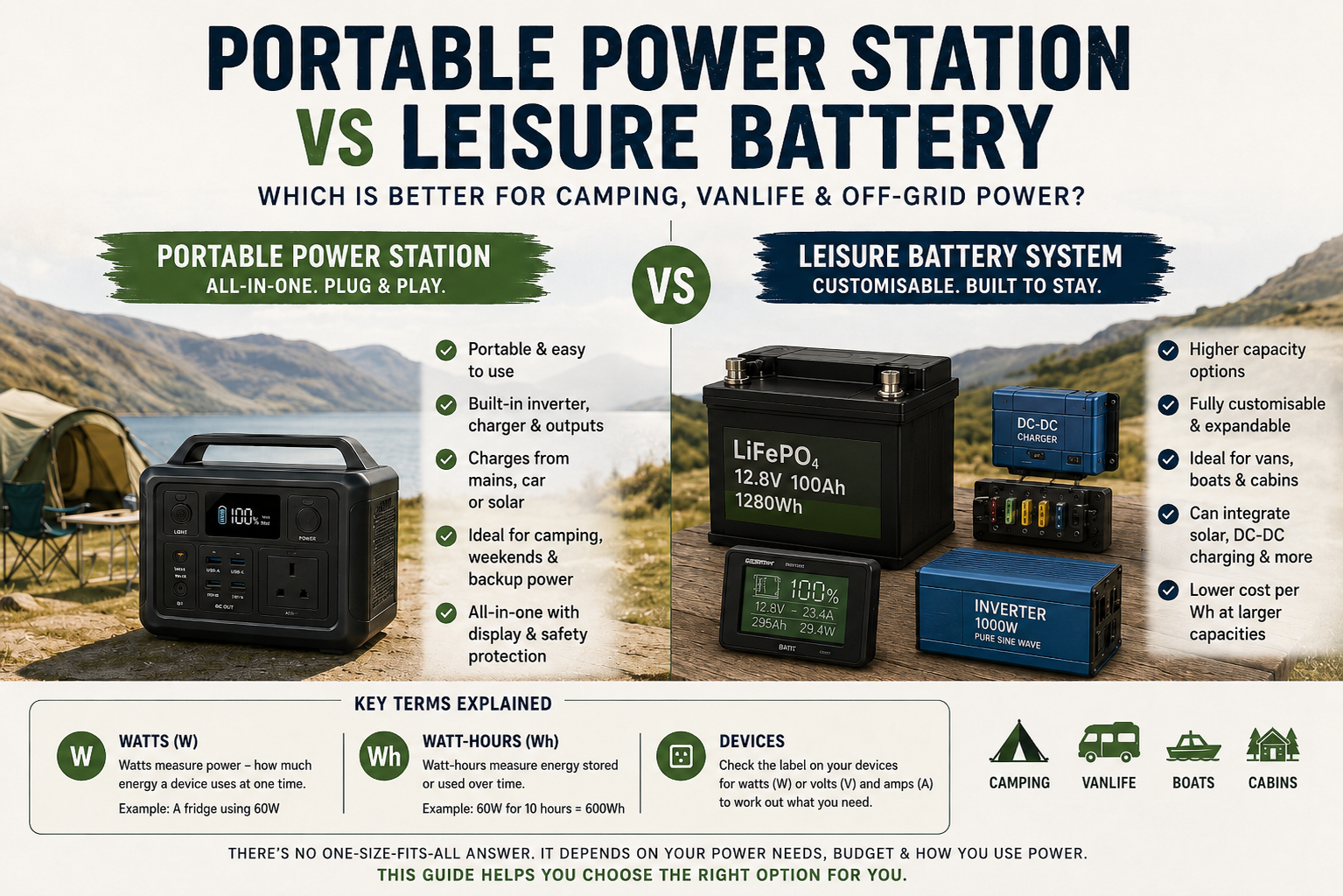
A portable power station is usually the better choice if you want a simple, plug-and-play power source for camping, vanlife weekends, festivals, photography, cabins, boats or emergency backup. It gives you a battery, inverter, charger, USB ports, mains sockets and display in one portable unit.
A leisure battery system may be better if you want a more permanent, expandable setup in a campervan, motorhome, liveaboard boat, cabin or off-grid build. It can be cheaper per watt-hour at larger sizes, more customisable and easier to integrate with fixed solar, alternator charging and onboard 12V appliances.
The best choice depends on how you use power. If you want convenience, portability and minimal setup, choose a portable power station. If you want a built-in system with more expansion and you are comfortable with proper installation, a leisure battery setup may make more sense.
This guide is general buying information, not electrical installation advice. Always follow manufacturer instructions. For fixed wiring, high-current DC systems, mains inverters, marine installations, home backup integration or larger off-grid systems, use a qualified professional.
For product context while you read, our portable power and lighting range is the simplest place to compare plug-and-play options. If you are planning a fixed system, it is worth looking at batteries and storage, charge controllers and chargers and inverters as separate parts of the same setup.
What is a portable power station?
A portable power station is an all-in-one rechargeable battery unit. Most models include:
- A built-in battery
- UK mains-style AC sockets
- USB-A and USB-C charging ports
- 12V DC output
- A built-in inverter
- A mains charger
- Solar charging input
- A display showing battery level, watts in and watts out
- Safety electronics and battery management
People use portable power stations for camping, vanlife, cabins, boats, outdoor work, photography, festivals, garden offices and home power-cut backup.
The big advantage is simplicity. You charge the unit, carry it where you need it, plug your devices in and use it. There is usually no separate inverter, battery monitor, fuse board, solar charge controller or DC distribution system to build.
That does not mean every power station suits every job. You still need to check capacity, output rating, charging input, battery chemistry, temperature limits and device compatibility. For many users, though, a portable power station removes most of the complexity.
What is a leisure battery?
A leisure battery is a battery designed to provide power for accessories, appliances and low-voltage systems when you are away from mains electricity. Leisure batteries are common in:
- Campervans
- Motorhomes
- Caravans
- Boats
- Cabins
- Sheds
- Off-grid solar systems
- 12V lighting and appliance setups
A leisure battery is usually only one part of a wider system. A typical setup may include:
- A lead acid, AGM, gel or LiFePO4 battery
- A battery box or mounting arrangement
- Fuses and cable protection
- Battery isolator or main switch
- DC distribution or fuse board
- Solar charge controller
- Solar panels
- Split charge relay or DC-DC charger for vehicle charging
- Battery monitor
- Inverter for mains-style appliances
- Shore power or mains charger where applicable
A leisure battery setup can be excellent, but it is not automatically simple. It needs to be sized, installed and protected properly. The battery is only one part of the system.
Portable power station vs leisure battery: quick comparison
| Feature | Portable power station | Leisure battery setup |
|---|---|---|
| Ease of use | Very easy; plug-and-play | Depends on system design and installation |
| Portability | Designed to move around | Usually fixed or semi-fixed |
| Installation | Minimal for basic use | Requires correct wiring, fusing and mounting |
| Expansion | Some models are expandable | Highly expandable if designed well |
| Upfront cost | Higher per Wh in some cases | Can be lower per Wh at larger capacities |
| Hidden costs | Usually fewer | Cables, fuses, charger, inverter, monitor and labour |
| Best for | Camping, weekends, flexible use, backup | Vans, boats, cabins, permanent systems |
| Solar charging | Usually built in, within input limits | Very flexible with the right controller |
| Inverter | Built in | Separate inverter needed if AC power is required |
| Maintenance | Usually low | Depends on battery type and system |
| User skill needed | Low to moderate | Moderate to high, or professional install |
| Safety complexity | Mostly inside the unit | Depends heavily on design and installation |
The main difference: plug-and-play vs custom system
The biggest difference is not just the battery. It is the whole approach.
A portable power station is a finished product. The battery, inverter, charger, display and outputs are already matched together by the manufacturer.
A leisure battery is a component. It needs the right supporting parts around it.
That is why a direct price comparison can be misleading. A 100Ah leisure battery might look cheaper than a power station, but it may still need a charger, inverter, DC-DC charger, solar controller, cables, fuses, box, monitor and installation work before it does the same job.
Cost comparison: which is cheaper?
A leisure battery can be cheaper if you are building a larger fixed system and you know exactly what you need. A portable power station can be better value for many users because so much is included.
With a power station, the price usually includes the battery cells, battery management system, inverter, mains charger, USB ports, 12V output, solar input, display, housing, cooling and protection electronics. You may only need to add solar panels or extra charging cables.
With a leisure battery setup, the battery is only the start. Depending on your use, you may also need a battery charger, inverter, DC-DC charger, solar charge controller, fuses, breakers, battery monitor, cables, terminals, mounting hardware, distribution panel and labour.
For occasional use, a portable power station is often the simpler and more cost-effective route. For a permanent campervan, boat or cabin system, a leisure battery setup can make financial sense, especially at larger capacities.
Capacity: watt-hours vs amp-hours
Portable power stations are usually sold in watt-hours, written as Wh. Leisure batteries are often sold in amp-hours, written as Ah. This can make comparison confusing.
A rough conversion for a 12V leisure battery is:
Watt-hours = amp-hours x volts
So a 100Ah 12V battery has a nominal capacity of:
100Ah x 12V = 1,200Wh
That does not mean you can always use all 1,200Wh. Usable capacity depends on the chemistry, battery management system, discharge limits and how the battery is used. A lead acid leisure battery is usually not treated the same as a LiFePO4 battery. Many users avoid deeply discharging lead acid batteries because it can shorten their life. LiFePO4 batteries often allow deeper usable discharge within manufacturer limits.
Output: what can each one actually run?
Capacity tells you how long you can run things. Output tells you what you can run at all.
A power station will usually list a continuous AC output rating, such as 300W, 600W, 1,000W or 2,000W. This tells you how powerful a mains-style device it can run. Some also list a peak or surge rating for devices with startup demand, but you should not plan to run appliances continuously at the surge rating.
A leisure battery by itself usually supplies DC power, often 12V. To run UK mains-style 230V appliances, you need an inverter. The inverter must be matched to the battery, cables, fuses, expected load, installation environment and appliance startup surge.
Charging: mains, solar, vehicle and shore power
Most power stations can charge from a wall socket, vehicle 12V socket, solar panels and sometimes USB-C or dedicated adapters. You can charge at home, take it away, top it up from solar and move it between the van, tent, boat, shed or house.
The limitation is input rating. A power station may accept only a certain solar voltage, wattage and connector type. It may also charge slowly from a vehicle socket.
A leisure battery system can be charged from solar panels through a solar charge controller, a vehicle alternator through a DC-DC charger, shore power through a mains charger, a generator through a suitable charger, or wind and other sources in some systems.
This can be more flexible, but it needs proper design. Modern vehicles often need a DC-DC charger rather than a simple split charge relay. LiFePO4 batteries may need compatible charging profiles. Marine and fixed systems may have additional considerations.
Weight, maintenance and upgrades
Portable power stations are designed to be moved. Even larger units often have handles and compact cases. They can be taken from the house to the van, from the van to the tent, from the boat to the workshop, or from the garage to the kitchen during a power cut.
Leisure batteries are usually heavier and less convenient to move, especially lead acid types. They are often installed in one place and left there.
A portable power station is usually low maintenance. You keep it charged, store it within its recommended temperature range, avoid overloading it and follow the manufacturer's instructions.
A leisure battery system depends on the battery chemistry and installation. Flooded lead acid batteries may need maintenance and ventilation. AGM and gel batteries are sealed but still need compatible charging. LiFePO4 batteries need suitable charging and battery management. All systems need appropriate fusing, cable protection and secure mounting.
Leisure battery systems can shine when you want expansion: more battery capacity, a larger solar array, additional DC circuits, a larger inverter, alternator charging, shore power and smart monitoring. Some power stations are expandable too, but usually within the manufacturer's ecosystem.
Safety and installation
A portable power station keeps most of the complexity inside a manufactured unit. That does not make it risk-free, but it reduces the amount of wiring and system design the user has to do.
A leisure battery system can involve high-current DC wiring, battery terminals, inverters, solar charging, vehicle charging, fuses, breakers, ventilation, cable routing, earthing and bonding considerations, plus marine or vehicle-specific issues.
High-current DC systems can be unforgiving if badly installed. Incorrect cable sizing, poor connections, missing fuses or unsuitable equipment can create serious risks.
Do not connect any battery system or power station into household wiring unless the system is specifically designed for that purpose and installed by a qualified person.
Which is better by use case?
Camping
For most camping trips, a portable power station is easier. It works well for phones, tablets, cameras, lights, small cool boxes, camping fridges, laptops, drones, CPAP machines where compatible, speakers and solar charging.
The main advantages are portability and simplicity. You can charge it at home, put it in the car, use it in the tent or awning, and take it home again.
Vanlife
For weekend trips, a portable power station is often ideal. It can run lights, phones, laptops, cameras and a camping fridge, depending on size. It avoids a full electrical installation and can be moved in and out of the van.
For full-time vanlife, a fixed leisure battery system may make more sense. A proper system can integrate with roof solar, alternator charging, 12V fridge, lights, water pump, diesel heater fan, USB outlets, inverter, battery monitor and shore power.
Boats
A portable power station can be useful on a boat for charging phones, laptops and cameras, running small devices, backup power and temporary use away from the main system.
A liveaboard boat usually needs a proper marine electrical system. Moisture, vibration, corrosion, cable protection and safety standards matter. For permanent onboard systems, use a properly specified marine setup.
Cabins and sheds
For occasional use, charging tools, running lights, laptop work or router backup, a portable power station may suit. For regular use, fixed lighting, larger solar panels, permanent DC circuits or larger battery storage, a leisure battery setup may make more sense.
Home backup
For home backup, a portable power station is often the easiest route for selected devices such as a WiFi router, laptop, phone chargers, LED lamp, small TV or some fridges and freezers depending on rating.
The key phrase is selected devices. A portable power station is not automatically a whole-house backup system.
Which is better for solar charging?
For simple solar charging, a portable power station is often easier. Many models have built-in solar charge control and clear input limits. You plug in a compatible panel and monitor charging on the screen.
For larger solar arrays, a leisure battery setup can be more flexible. You can choose the solar charge controller, panel size, battery capacity and wiring design. That flexibility comes with more complexity.
For a soft next step, compare portable solar panels and fixed panels in the solar panels range, then check the input limits of the power station or charge controller you plan to use.
Which should you choose?
Choose a portable power station if:
- You want plug-and-play power
- You want one unit for camping, home, van and outdoor use
- You do not want fixed wiring
- You want built-in AC sockets, USB, charging and display
- You value portability and simplicity
- You only need to power selected devices
Choose a leisure battery setup if:
- You are building a permanent van, boat, cabin or off-grid system
- You want custom wiring and integrated 12V circuits
- You need larger or expandable storage
- You are comfortable with proper system design
- You want to integrate solar, alternator and shore charging
- You are prepared to install fuses, cabling, monitoring and protection correctly
Final thoughts
For many people, a portable power station is the easiest and most sensible starting point. It is compact, simple, movable and ready to use.
A leisure battery system is better when the power system itself becomes part of the vehicle, boat, cabin or building. It can be more flexible and more cost-effective at larger sizes, but it needs proper design and installation.
The better choice is the one that matches how permanent, expandable and hands-on you want your off-grid power setup to be.
FAQs
Is a portable power station better than a leisure battery?
It depends on the use. A portable power station is usually better for simple, movable, plug-and-play power. A leisure battery setup is usually better for permanent, expandable systems in vans, boats, cabins and off-grid builds.
Can a portable power station replace a leisure battery?
For some users, yes. It can replace a leisure battery for camping, weekend vanlife and selected-device backup. It may not replace a properly installed leisure battery system for long-term vanlife, liveaboard boats or fixed off-grid systems.
Is a leisure battery cheaper than a power station?
The battery alone may be cheaper, but a full leisure battery setup can need chargers, cables, fuses, inverter, controller, monitor, mounting parts and installation. Compare the whole system, not just the battery.
Which is better for camping?
For most camping, a portable power station is easier because it is self-contained and portable. A leisure battery can work, but it is usually less convenient unless already built into a caravan or vehicle.
Which is better for vanlife?
For weekend vanlife, a portable power station is often enough. For full-time or long-term vanlife, a fixed leisure battery system may be better because it can integrate with solar, alternator charging and onboard 12V circuits.
Can I charge both from solar panels?
Yes, but the setup is different. Many portable power stations include built-in solar input. Leisure batteries usually need a separate compatible solar charge controller.
Do I need an inverter with a leisure battery?
Only if you want to run UK mains-style 230V appliances. The inverter must be correctly sized and installed with suitable cables and fusing.
Are portable power stations safe?
Quality power stations used within their specification can be safe and convenient. You still need to follow manufacturer instructions, avoid overloading the unit and use compatible charging equipment.