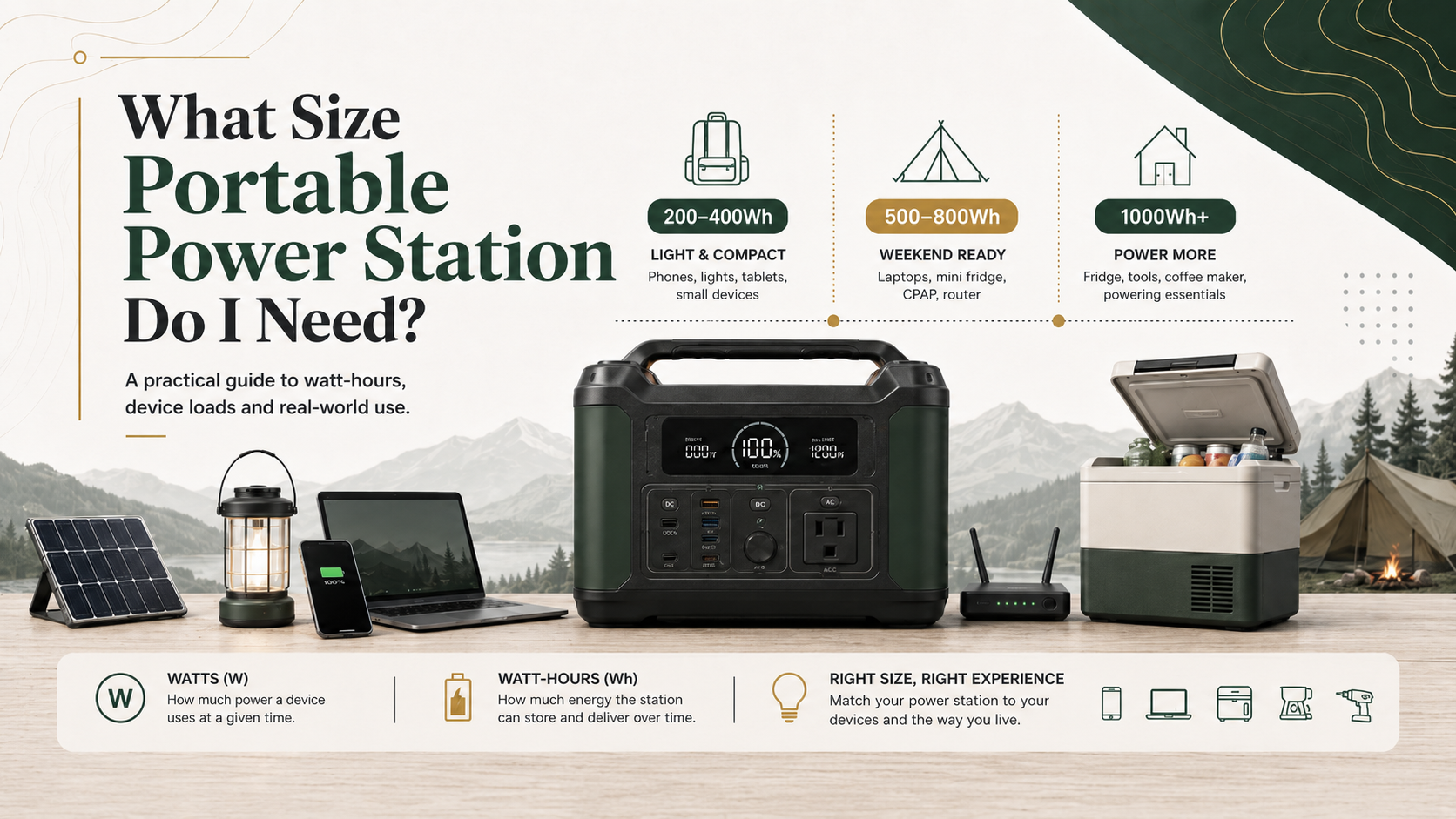
The right size portable power station depends on what you want to run, how much power each device uses, how long you need to run it for, and how much margin you want for real-world conditions.
For quick orientation:
| If you need to power... | Start looking around... |
|---|---|
| Phones, lights and camera batteries | 200Wh-400Wh |
| Laptop, router, lights and weekend use | 500Wh-800Wh |
| Camping fridge plus devices | 800Wh-1,200Wh |
| Vanlife, boats, cabins and heavier use | 1,000Wh-2,000Wh |
| Home backup or expandable off-grid setup | 1,500Wh-3,000Wh+ |
This is only a starting point. The better answer comes from your own devices.
If you want to compare suitable products after doing the sums, start with the portable power and lighting range. For recharging from sunlight, cross-check the unit against compatible solar panels.
The simple calculation
Use this formula:
Watts x hours = watt-hours
If a laptop uses 60W and you want to run it for 4 hours:
60W x 4 hours = 240Wh
That means the laptop needs roughly 240Wh of energy. If you also want to charge phones, run lights or power a fridge, add those devices too.
Step-by-step: check your devices
Before buying a power station, look at the devices you actually want to use. You are looking for a label, sticker, plug marking or charger rating. It may be on:
- The device itself
- The plug or power adapter
- The underside of the product
- The back of a fridge, TV or monitor
- The laptop charger brick
- The product manual
- The manufacturer's website
You may see the power listed in watts, amps, volts or a combination.
If the label shows watts
This is easiest. Look for markings such as:
Power: 60WInput: 230V ~ 50Hz 60WRated power: 45WMax power: 100W
If it says 60W, use 60 watts in your calculation.
60W x 8 hours = 480Wh
If the label shows volts and amps
Some labels do not show watts. They may show volts and amps instead.
Use:
Watts = volts x amps
For UK mains-powered devices, you may see:
Input: 230V ~ 0.5A
230V x 0.5A = 115W
For low-voltage DC devices:
Output: 12V 5A
12V x 5A = 60W
For USB-C chargers, use the maximum listed output if planning conservatively. A charger marked 20V 5A can draw up to 100W.
If the label shows mA instead of A
Some small electronics list current in mA, or milliamps.
1,000mA = 1A
So:
5V 2,000mA
5V x 2A = 10W
Use actual running watts where possible
Labels often show a maximum rating. Many devices do not use their maximum power all the time.
- A laptop charger may be rated at 65W, but the laptop may only draw 20W-50W during normal use.
- A fridge may use 50W when the compressor is running, but it cycles on and off.
- A TV may have a maximum rating that is higher than its normal viewing consumption.
- A camera charger may draw less once the battery is nearly full.
If your power station has a screen showing real-time power draw, you can plug in a device and see how many watts it actually uses. For planning before purchase, use the label as a conservative estimate, then refine later.
Build your own power list
| Device | Watts | Hours per day | Energy needed |
|---|---|---|---|
| Laptop | 60W | 4 hours | 240Wh |
| Phone charging | 15W | 2 hours | 30Wh |
| LED light | 10W | 5 hours | 50Wh |
| Camping fridge | 50W | 8 hours | 400Wh |
| Camera batteries | 20W | 2 hours | 40Wh |
Total:
240Wh + 30Wh + 50Wh + 400Wh + 40Wh = 760Wh
Now add a margin. A sensible planning margin is usually around 20-30%.
760Wh x 1.25 = 950Wh
In this example, a customer should probably look at a power station of around 1,000Wh or more, especially if they want comfort, cloudy-day flexibility or future expansion.
Why you should add a margin
Do not size everything to the absolute limit. A margin helps because real life is messy.
A margin allows for:
- Inverter losses
- Cold weather effects
- Devices using more power than expected
- Batteries not being used from 100% to 0%
- Extra phone, camera or laptop charging
- Longer evenings
- Cloudy weather if using solar
- Battery ageing over time
- Future devices you forgot to include
For casual use, a 20% margin may be enough. For more serious off-grid use, backup power or work-critical setups, 30% or more can be more comfortable.
Check both capacity and output
A common mistake is only looking at battery capacity. You need to check two things.
Battery capacity
Capacity is usually shown as watt-hours, or Wh.
Examples:
300Wh512Wh768Wh1,024Wh2,048Wh
This tells you roughly how long the power station can run your devices.
AC output or inverter rating
Output is usually shown as watts, or W.
Examples:
300W output600W output1,000W output2,000W output
This tells you how powerful a device the power station can run.
A 1,000Wh power station with a 600W inverter may have decent battery capacity, but it still cannot run a 2,000W kettle. The inverter rating would be too low.
Continuous power vs surge power
Many power stations list two output numbers:
- Continuous power
- Peak or surge power
Continuous power is what the power station can supply steadily. Surge power is a short burst for devices that need extra power when they start up, such as compressors or motors.
For buying decisions, focus mainly on the continuous power rating. Surge rating can be useful, but you should not plan to run devices continuously at the surge number.
Portable power station size guide
Small power stations: 200Wh-400Wh
Small power stations are useful for simple, lightweight use.
They may suit phone charging, camera batteries, LED lights, small speakers, tablets, occasional laptop charging, short camping trips, day trips and emergency phone or laptop backup.
They are usually not ideal for running fridges for long periods, kettles, heaters, power tools, multi-day off-grid use or home backup beyond small electronics.
Medium power stations: 400Wh-800Wh
Medium units offer more flexibility without becoming too large.
They may suit laptop working, phones and tablets, LED lighting, camera charging, small cool boxes or efficient fridges for shorter periods, WiFi router backup, camping trips and light vanlife use.
Large power stations: 800Wh-1,500Wh
This is often the sweet spot for serious portable use.
They may suit compressor camping fridges, laptops and monitors, router backup, lights, camera or drone batteries, vanlife weekends, boat weekends, cabin or shed use, longer camping trips and backup for selected home devices.
A 1,000Wh-class unit can be a strong all-rounder, especially when paired with solar charging.
Extra-large power stations: 1,500Wh-3,000Wh+
Large and expandable systems are better for longer use or heavier loads.
They may suit regular vanlife or liveaboard use, cabins and remote buildings, longer power cuts, running multiple devices, portable fridge plus laptops plus lighting, higher-power tools within limits and more serious solar charging setups.
What size power station do I need for common jobs?
Camping
For simple camping with phones, lights and camera batteries, a 200Wh-400Wh unit may do the job.
If you want to run a camping fridge, charge laptops, power lights and keep devices going for a weekend, look more towards 700Wh-1,200Wh.
Vanlife
For light weekend vanlife, a 500Wh-1,000Wh power station may be enough for phones, lights, laptops and small devices.
For a fridge, laptops, lighting, camera gear and regular off-grid use, 1,000Wh-2,000Wh is often more realistic.
For full-time vanlife, remote work or longer trips, many people look at larger or expandable systems, especially if they want solar charging and inverter output for bigger devices.
Fridges
Fridges vary a lot. A small compressor camping fridge may use around 40W-80W while the compressor is running, but it will usually cycle on and off. A domestic fridge may use more, especially at startup.
Example:
60W average running draw x 10 hours = 600Wh
600Wh x 1.25 margin = 750Wh
For fridge use, many buyers look at 800Wh-1,200Wh+, depending on fridge type, ambient temperature, runtime and what else they want to power.
Laptops
A small efficient laptop may use 30W-45W. A larger laptop or workstation may use 65W-100W or more.
65W laptop x 4 hours = 260Wh
260Wh x 1.25 margin = 325Wh
For laptop work alone, a 300Wh-500Wh unit may be enough. If you also need a monitor, WiFi router, lights, phone charging and a longer workday, look at 500Wh-1,000Wh+.
Router backup
Many home routers use around 10W-20W, though this varies.
15W router x 8 hours = 120Wh
120Wh x 1.25 margin = 150Wh
For router-only backup, even a small power station may be enough. For a router, laptop, phone chargers and lights during a power cut, a 500Wh-1,000Wh unit is more comfortable.
What about kettles, heaters and high-power appliances?
Kettles, fan heaters, toasters, microwaves, hairdryers and some cooking appliances can use a lot of power.
Examples:
- Travel kettle: often
600W-1,000W - Standard kettle: often
2,000W-3,000W - Electric heater: often
1,000W-2,000W - Hairdryer: often
1,200W-2,200W - Microwave: often
700W-1,500Winput or more
A 2,000W kettle can drain a battery very quickly and may exceed the output rating of many power stations.
2,000W kettle used for 6 minutes
6 minutes = 0.1 hours
2,000W x 0.1 hours = 200Wh
Heating air or water with electricity is one of the fastest ways to empty a portable battery.
Can solar panels make the power station smaller?
Solar panels can help recharge a power station, but they do not remove the need for enough battery capacity.
Solar charging depends on panel wattage, sun angle, weather, shade, season, panel placement, charge controller efficiency and the power station input limit.
A 200W solar panel will not usually deliver 200W all day in real UK conditions. Output changes constantly with weather, angle and shade.
A sensible off-grid setup balances both:
- Enough battery to cover your loads
- Enough solar input to recharge within a realistic time
For this part of the system, compare solar panels and check the input voltage and wattage limits of the power station before pairing anything together.
Quick sizing examples
Simple weekend camping
| Device | Watts | Hours | Energy |
|---|---|---|---|
| Phone charging | 15W | 2h | 30Wh |
| LED light | 10W | 5h | 50Wh |
| Camera charger | 20W | 2h | 40Wh |
Total: 120Wh
With margin: 150Wh-200Wh
Suggested size: 200Wh-300Wh
Laptop work day
| Device | Watts | Hours | Energy |
|---|---|---|---|
| Laptop | 65W | 6h | 390Wh |
| Phone | 15W | 2h | 30Wh |
| Router | 15W | 6h | 90Wh |
| LED light | 10W | 3h | 30Wh |
Total: 540Wh
With margin: 675Wh
Suggested size: 700Wh-1,000Wh
Vanlife weekend with fridge
| Device | Watts | Hours | Energy |
|---|---|---|---|
| Camping fridge | 50W | 10h | 500Wh |
| Laptop | 60W | 3h | 180Wh |
| Phone charging | 15W | 3h | 45Wh |
| Lights | 10W | 5h | 50Wh |
| Camera/drone chargers | 40W | 2h | 80Wh |
Total: 855Wh
With margin: 1,070Wh
Suggested size: 1,000Wh-1,500Wh
Power cut essentials
| Device | Watts | Hours | Energy |
|---|---|---|---|
| Fridge/freezer | 80W | 8h | 640Wh |
| WiFi router | 15W | 8h | 120Wh |
| Phone charging | 15W | 2h | 30Wh |
| LED lamp | 10W | 5h | 50Wh |
| Laptop | 60W | 3h | 180Wh |
Total: 1,020Wh
With margin: 1,275Wh
Suggested size: 1,500Wh+
Common mistakes
- Confusing watts and watt-hours
- Forgetting inverter output
- Planning to run heaters for long periods
- Forgetting startup surge from fridges, pumps and tools
- Assuming solar always produces its rated output
- Buying with no margin
Safety and compatibility notes
Portable power stations are convenient, but they still store significant energy. Follow the manufacturer's instructions, use compatible solar panels and cables, do not exceed input or output ratings, keep ventilation areas clear, avoid damaged cables, and do not use unsupported adapters or modifications.
Do not connect a power station into household wiring unless the system is designed for that and installed by a qualified person.
Final thoughts
Choosing a portable power station is not about buying the biggest unit you can find. It is about matching battery capacity, output rating and charging options to the way you actually use power.
Start with your real devices. Read the labels. Add up the watts. Estimate your hours. Add a margin. Then choose the power station that gives you enough usable energy without unnecessary bulk or cost.
FAQs
What size portable power station do I need for camping?
For simple camping with phones, lights and camera charging, a 200Wh-400Wh power station may be enough. If you want to run a camping fridge, laptop and lights for a weekend, look closer to 700Wh-1,200Wh.
What size portable power station do I need for a fridge?
Many people look at 800Wh-1,200Wh or larger for fridge use, depending on the fridge type, runtime and outside temperature. Always check the fridge wattage and add a margin.
What size portable power station do I need for a laptop?
For a laptop alone, 300Wh-500Wh may be enough for several hours of work. For a full remote-work setup with router, lights, monitor and phone charging, 700Wh-1,000Wh may be more comfortable.
How do I calculate power station size?
Multiply each device's watts by the number of hours you want to use it. Add the watt-hours together, then add around 20-30% margin.
What is the difference between watts and watt-hours?
Watts measure how much power a device uses at one moment. Watt-hours measure how much energy a battery stores or a device uses over time.
Can a portable power station run a kettle?
Only if the power station's inverter is rated high enough for the kettle. Many kettles use 2,000W-3,000W, which is too much for many portable units and can drain the battery quickly.
Can a portable power station run a heater?
Some can, if the output rating is high enough, but electric heaters use a lot of energy and can drain a battery quickly. Heating is usually one of the hardest jobs for portable battery systems.
Is a bigger power station always better?
Not always. Bigger units cost more, weigh more and take longer to recharge. The best size is the one that fits your devices, runtime and charging setup with enough margin.
How much margin should I add when sizing a power station?
A margin of around 20-30% is a sensible starting point. More margin may be useful for winter, cloudy weather, fridge use, backup power or critical devices.
Can I charge a portable power station with solar panels?
Many portable power stations can be charged from solar panels, but compatibility and input limits matter. Check the power station's solar input specification and use manufacturer-approved or compatible panels and cables.