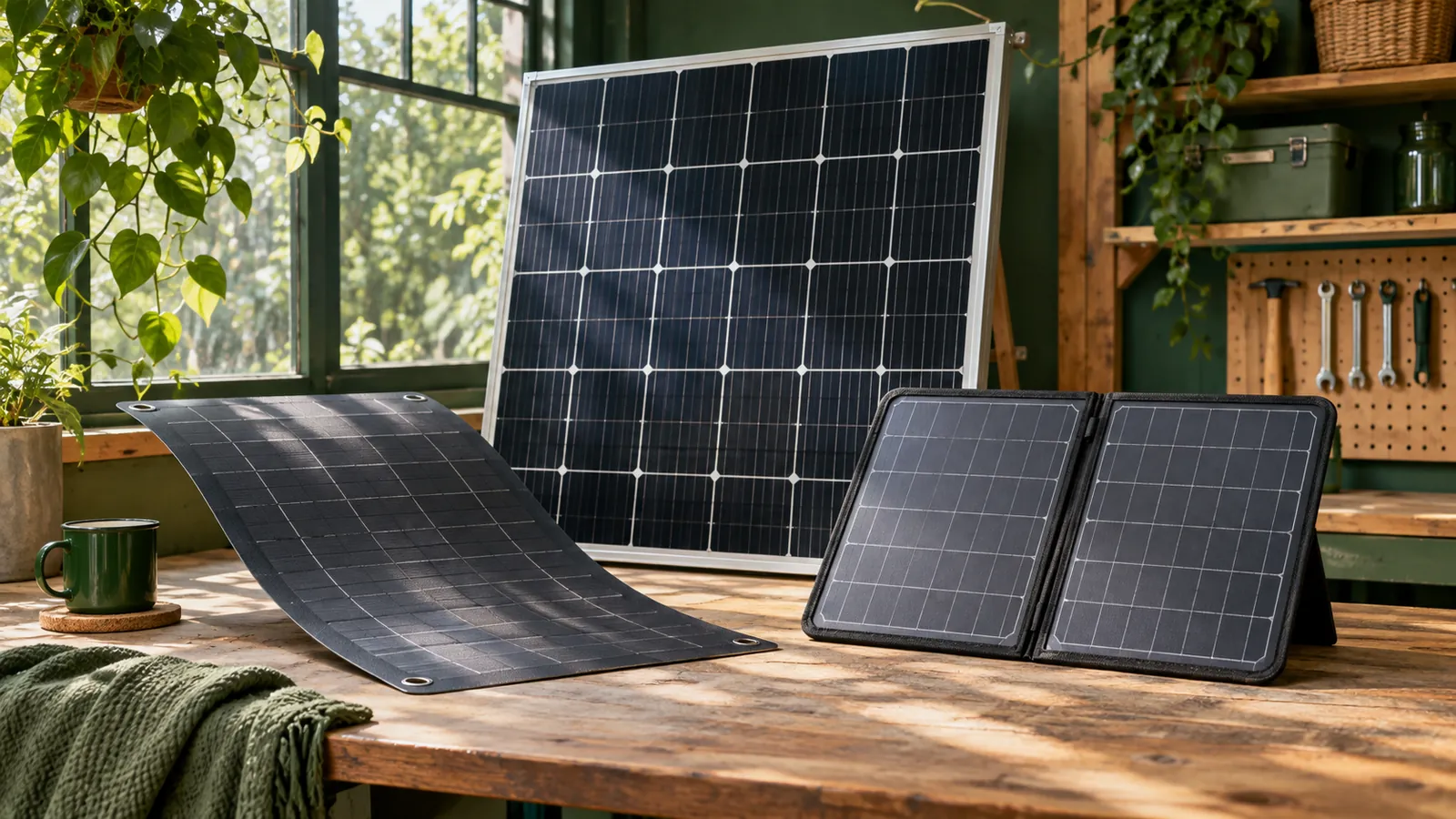
Solar panels come in formats that suit different ways of using power. A rigid panel can form part of a permanent mounted array; a flexible CIGS panel offers another option for suitable surfaces; a folding panel can be deployed while you stop and packed away for travel.
Start with where the panel will go and how you want to use it. Then compare dimensions, mounting requirements and the charging equipment it will connect to. This approach makes the choice clearer than comparing wattage alone.
Choose between fixed and portable use
For a permanent installation, measure the available area and identify the mounting surface. The manufacturer's fixing instructions set out the support, permitted curvature and any clearance requirements for that model.
For a portable setup, compare packed dimensions, weight, deployed size and cable reach. Plan where you will stand the panel during use and store it while travelling, within its environmental limits.
| Format | Where to start |
|---|---|
| Rigid panel | A mounting arrangement that secures the frame to a suitable surface |
| Flexible CIGS panel | A suitable surface and model-specific curvature, adhesive or fixing requirements |
| Folding panel | Convenient carrying and storage, a deployment position and compatible charging equipment |
Browse CIGS panels, rigid folding panels and the wider solar-panel range to compare the available formats.
Find a panel shape that works with your layout
The SELM2-165 is listed as a 165W flexible CIGS panel with self-adhesive backing. This format provides a mounting option for a suitable prepared surface, subject to its dimensions and installation instructions.
Compare sizes model by model. Panels with similar rated outputs can occupy different shapes and areas, which matters around vents, rooflights and access routes. For flexible panels, confirm the permitted curvature and surface preparation. Flexibility and adhesive backing do not make every roof or surface suitable.
Match the panel to your charging equipment
Bring the panel's voltage and current specifications together with the charge controller or power station's documented input limits. For multiple panels, assess the proposed series/parallel arrangement as a whole.
Confirm polarity and cable requirements as well as connector type: physically matching connectors alone do not establish electrical compatibility. For battery charging, compare suitable charge controllers alongside the panels and battery.
Plan energy around the installation
Give the panel the best practical access to sunlight and use comparable manufacturer data when weighing up technologies. Shade, angle, temperature and season affect output, so the format alone cannot tell you which panel will generate more energy at your site.
Rated watts describe output under stated test conditions. Use the expected charging opportunities and your appliance demand to plan daily energy needs separately from the physical fit.
Bring your measurements to the shortlist
Keep panel dimensions, mounting instructions and your charger's or power station's input specifications together. If you need help interpreting a listing, send the model numbers and the space you have available. Explore our solar-panel range to compare formats and specifications, then use the selected panel’s mounting instructions to complete your plan.