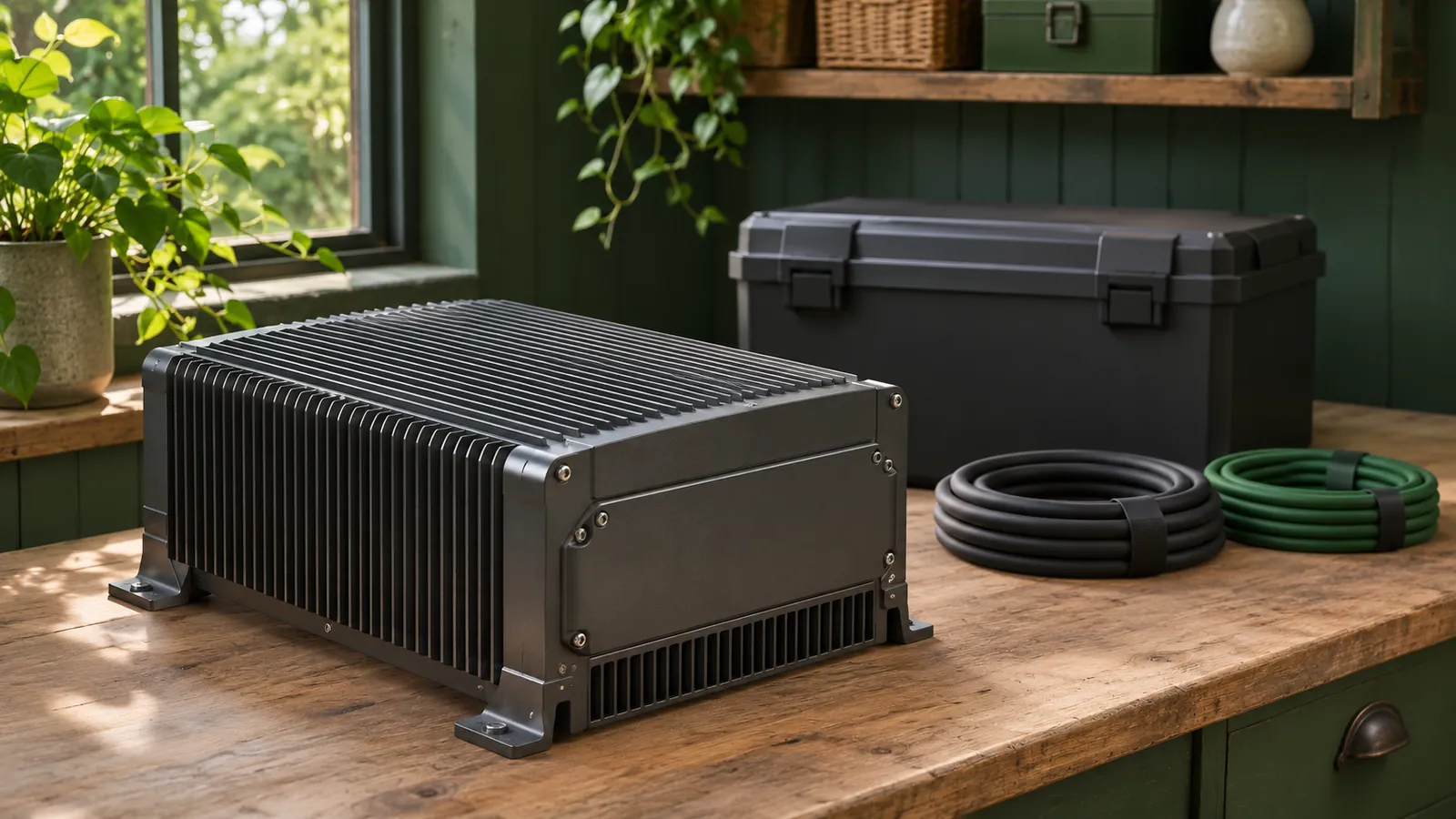
A 48V inverter lets a compatible battery bank supply AC equipment, opening up options for appliances in an off-grid cabin, workshop or other planned battery system. Choosing the output rating around the equipment you use gives you a practical starting point.
Use the 48V off-grid inverter range to compare models, then match the inverter and battery to the same load list. The 48V label describes the battery-system class; output watts and usable battery energy tell you about appliance power and runtime.
1. Start with the appliances you use together
List each appliance's input power and note which ones run at the same time. A maximum label rating can be a conservative starting point; measured running power often gives a better energy estimate.
| Your requirement | Specification to compare |
|---|---|
| Equipment running together | Continuous output rating and any temperature derating |
| Motors, compressors or pumps starting | Surge capability, its permitted duration and the load's startup demand |
| Sensitive or specialist equipment | Manufacturer-approved supply characteristics as well as wattage |
| A full day's use | Battery energy, usable discharge allowance and conversion losses |
For AC equipment, multiplying volts by amps gives apparent power in VA, which may differ from real power in watts. Use the real wattage for energy calculations and check both relevant output limits when choosing an inverter. Pure sine wave output is one part of that compatibility assessment.
2. Choose output power and runtime separately
The IPR-1000-48 lists 1000W output, while the IPR-3000-48 lists 3000W. Both are 48V pure sine wave models with remote on/off control. Compare their output ratings with your simultaneous loads; choose battery capacity around the time you want to run them.
For illustration, dividing 2000Wh by a 500W AC load gives four hours before allowances. Actual usable runtime is lower once discharge limits, conversion losses and inverter consumption are included. The runtime calculator lets you explore these assumptions, then refine them using your chosen equipment's specifications.
3. Pair the inverter with the battery bank
Match the inverter's supported DC input range to the battery's operating-voltage range. For lithium batteries, include BMS discharge limits and any required communication protocol. Nominal 48V batteries can have different operating and charging requirements.
The bank needs to support continuous demand and startup events. Give the installer the exact battery and inverter models, cable distances and installation environment so cable sizes, fuses and terminations can be designed together. AC wattage alone is insufficient for that design.
4. Choose the charging functions you need
An inverter supplies AC power from the battery. An inverter/charger may also accept an AC supply to recharge the bank, while a hybrid model may include solar charge control. Comparing the individual functions helps you decide which equipment to include and which charging sources to plan for.
For a connection to household wiring, grid export or backup changeover, have a qualified professional assess the intended arrangement. A pure sine wave output or “hybrid” label does not establish approval for these uses.
Make a useful shortlist
Keep your appliance list, battery model, charging sources and available mounting space alongside the product specifications. Send us the model numbers if you need help interpreting a listing. If you prefer to compare packages, the complete solar kit guide explains how panels, batteries and inverter ratings fit together.
Explore 48V inverters
Compare output ratings and product specifications in our 48V off-grid inverter range. Keep your battery model and appliance list handy, and use each product's specifications and supplied manual to confirm the combination.