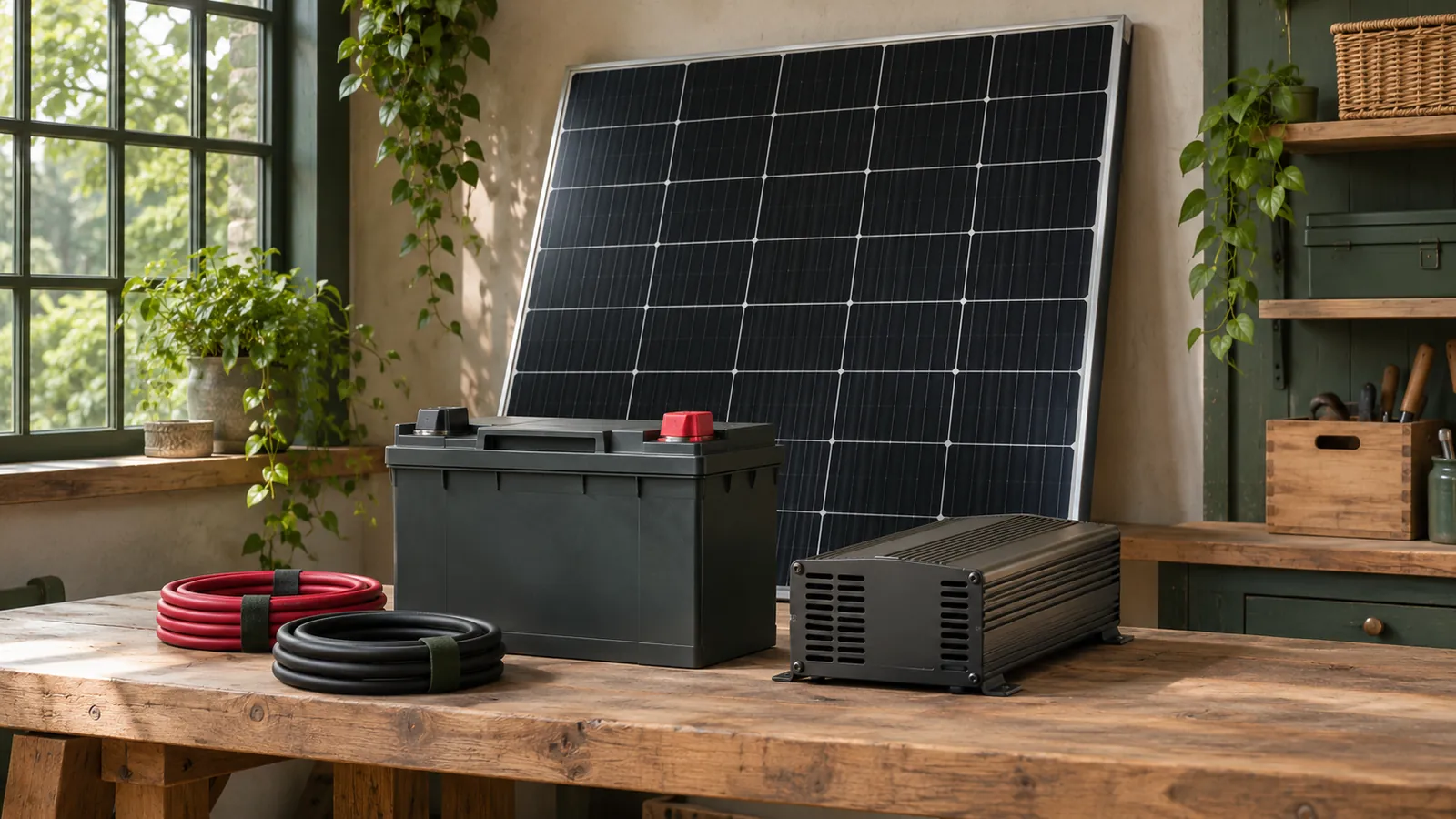
A solar kit brings key components together, making it easier to plan power for a cabin, outbuilding or battery system. The right package starts with the job: charging a battery you already own, adding dedicated lighting or supplying appliances from a complete off-grid setup.
This guide helps you compare kit types, understand the three main power and storage figures, and build a shortlist around your daily use.
Choose a package for the job
| Kit type | What it helps you do | Main contents to compare |
|---|---|---|
| Battery charging kit | Replenish a supported existing battery | Panel, controller, leads, connectors and mounting parts |
| Dedicated lighting kit | Light an outbuilding with the specified lamps | Panel, battery/control unit, lights and cable runs |
| Complete off-grid system | Store energy and supply supported loads away from the grid | Array, battery bank, inverter/charger, wiring and protection |
| Grid-connected package | Add solar equipment to a designed mains-connected system | Array, inverter, storage where included, and installation requirements |
Browse off-grid kits for independent power and grid-tie packages for a proposed grid-connected installation. Your installer should confirm the appropriate connection arrangement; the word “hybrid” alone does not establish suitability for a property.
Compare generation, storage and appliance power
Panel watts describe rated generating power. They help you compare arrays, while daylight, shade, season and installation determine actual energy production.
Battery capacity describes stored energy. Compare voltage and capacity together, then account for usable discharge limits and conversion losses when estimating energy available to appliances.
Inverter watts describe supported AC power. Compare continuous output with the appliances you run together, and surge capability with their startup requirements.
The KIT3K-820-4 complete system illustrates all three: it specifies two 410W Sharp panels, a 3kW 24V hybrid inverter and four 100Ah AGM batteries. The panels total 820W rated output; the 3kW figure describes inverter output. To work out the bank's configured Ah, use the batteries' connection arrangement rather than simply adding their labels.
Build a complete project budget
A clear contents list makes packages easier to compare. Mark each part as included, separately required or still to be confirmed:
- Panels and their mounting system.
- Charge control and any mains or vehicle charging equipment.
- Battery bank, connections and enclosure requirements.
- Inverter and remote control, if needed.
- Cables of appropriate type and length.
- Connectors, protection, isolation and distribution equipment.
- Installation, commissioning and any site-specific work.
This gives you a more useful budget than the kit price alone. Supplied connection cables cover the package's stated contents; your roof construction, cable distances and final circuit design may call for additional parts.
Size the system around your day
List the appliances, their average running demand and hours of use. Note which run together and which have startup demand. The daily energy total helps assess storage and charging; simultaneous and startup loads help assess inverter output.
Include electric heating and cooking carefully, as these can account for a large share of the energy budget. The power-station sizing guide explains watts and watt-hours with worked examples that also help when planning a fixed system.
Take your shortlist to an installer
Bring your load list, shortlisted kit and component documentation to a qualified installer for fixed AC or grid-connected work. They can assess the intended configuration and site-specific requirements before you purchase the equipment.
Compare complete solar packages
Browse our off-grid solar kits to compare panel output, battery storage and inverter power together. For a planned mains-connected installation, explore grid-tie solar packages with your installer and confirm the equipment list against the project design.