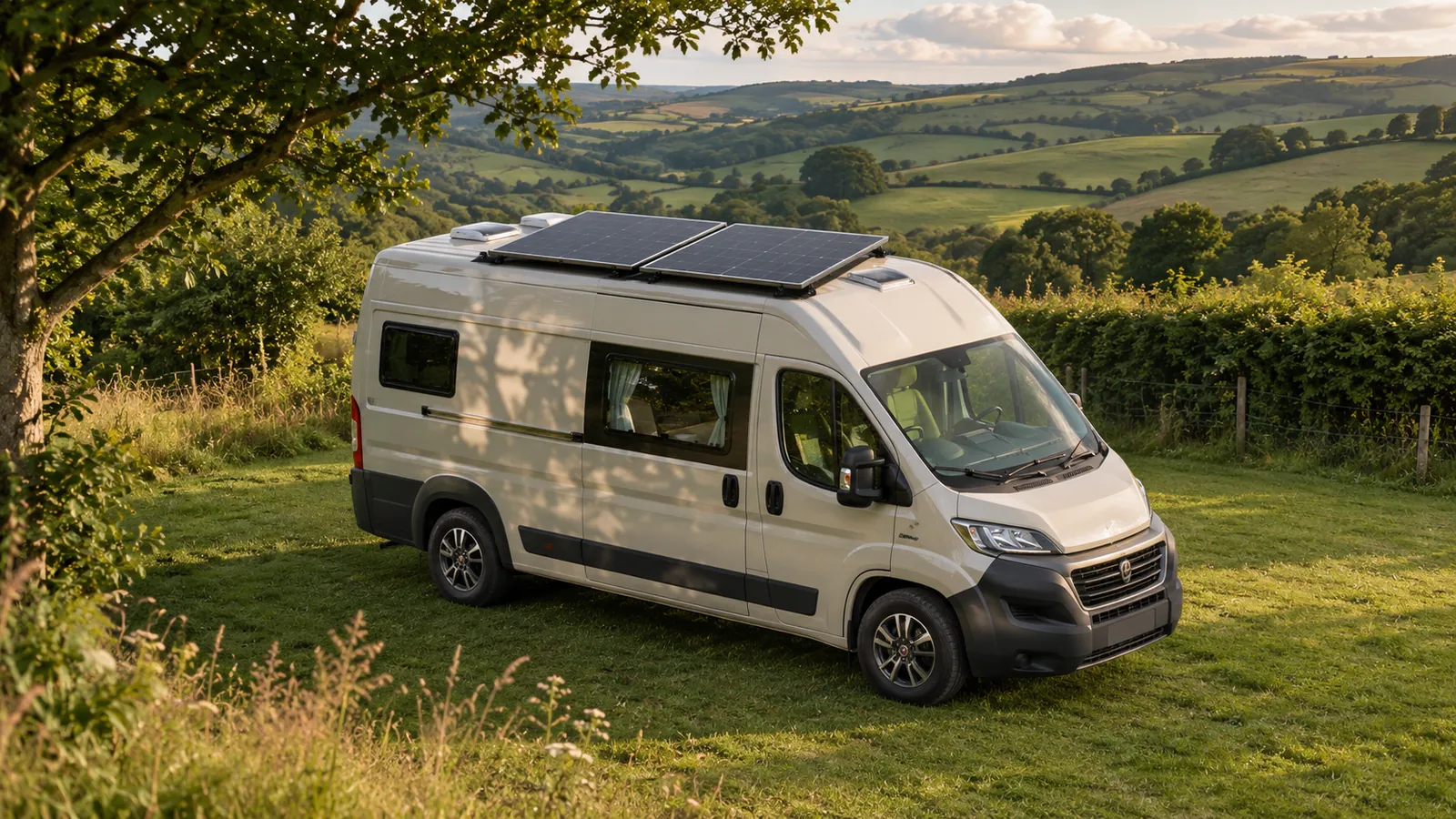
Solar charging can help replenish your leisure battery while your van is parked, ready for the next evening's lights, device charging and other onboard essentials. A well-chosen kit brings the key components together and gives your conversion a clear starting point.
The best match depends on your roof space, battery system and the appliances you use. Gather the existing battery and charger model numbers, sketch the roof and make a short appliance list. With those details, you can compare van conversion kits on what they will contribute to your setup.
1. Make the most of your roof space
Measure around vents, rooflights, aerials and other fittings. Allow for access, the manufacturer's mounting requirements and the cable-entry route. A panel's dimensions tell you how it fits into that layout; its wattage tells you its rated generating power.
Flexible and semi-flexible panels offer different mounting options, each with a permitted curvature and fixing method. A folding panel is another option when you prefer to deploy it while parked and stow it for travel. Compare the available mounting or storage space as well as output.
2. Match charging to your leisure battery
Record the battery's nominal voltage, chemistry, capacity and charging requirements. Keeping the solar controller, mains charger and vehicle charging equipment compatible lets each charging source support the same battery system.
For an AGM-to-LiFePO4 upgrade, compare the required charging profiles, BMS limits and low-temperature charging provisions. Our battery chemistry guide explains the differences; use the exact battery and charger manuals to confirm the combination.
3. Plan how you will recharge on the road
Solar charging while parked and alternator charging while driving serve different parts of a trip. A “dual battery” solar kit commonly describes support for a starter and leisure battery arrangement. Confirm its supported battery types and connections; the term alone does not mean alternator charging is included.
If you want charging while driving, compare a compatible DC-to-DC charger. Vehicle compatibility includes the alternator and any engine-running or ignition signal, alongside the battery specifications.
4. Understand what each power rating buys you
The VANDBKIT-1000 package includes two 130W panels, a 100Ah AGM battery and a 1000W pure sine wave inverter. That gives you three separate figures to compare: 260W of rated solar generation, the battery's storage capacity and 1000W of inverter output.
The inverter rating helps you shortlist appliances it can supply, allowing for continuous and startup demand. Daily energy use and charging opportunities help you size the panels and battery. The “1kW” package label refers to inverter output, rather than the panels' generating power.
5. Turn the kit into an installation plan
| Part of the project | Details to bring together |
|---|---|
| Panel installation | Mounting method, roof suitability and cable entry |
| Charging equipment | Battery profiles, array limits and included sensors or displays |
| Battery connections | Terminal sizes, cable lengths and protection |
| AC equipment | Inverter ratings and the installation design |
| Monitoring | Included functions and any additional interface needed |
Mark what is included in the package and what your van needs separately. Send us the kit SKU and existing equipment model numbers if you need help interpreting a listing. Have a qualified installer confirm the electrical design and installation requirements for your vehicle.
Find a kit for your van
Browse our van conversion kits to compare panels, battery storage and inverter output in one place. For charging while driving, explore our DC-to-DC battery chargers alongside your vehicle and leisure-battery specifications.